Why Strategic Planning Is Crucial for Your Business

Strategic business planning is the process of deciding where your business is going, what matters most, and how progress will be measured over the medium to long term. It gives business owners a way to step back from day-to-day activity and create a clear direction for growth. Think of it as stepping away from daily operations to consider where the business is headed and what its priorities should be.
This article explains what strategic planning is, why it matters, and how to build a practical strategic planning process that leads to real results. It also distinguishes strategic business planning from operational planning and shows how the right external support can turn broad ambition into clear, measurable action.
The perspective throughout is grounded in practical business experience: strategy only works when it is simple enough to use, strong enough to guide decisions, and flexible enough to support real-world business growth.
Key Takeaways
- Strategic planning is about long-term direction, not just short-term activity.
- A strong strategic planning framework helps a business align objectives, goals, solutions, people, and resources.
- The benefits of strategic planning include clearer direction, better alignment across teams, smarter resource use, and stronger progress toward business goals.
- A good strategy depends on involving the right people, including key employees, customers, and trusted advisers.
- A business mentor can help turn strategic development into practical, accountable action.
What Is Strategic Planning?
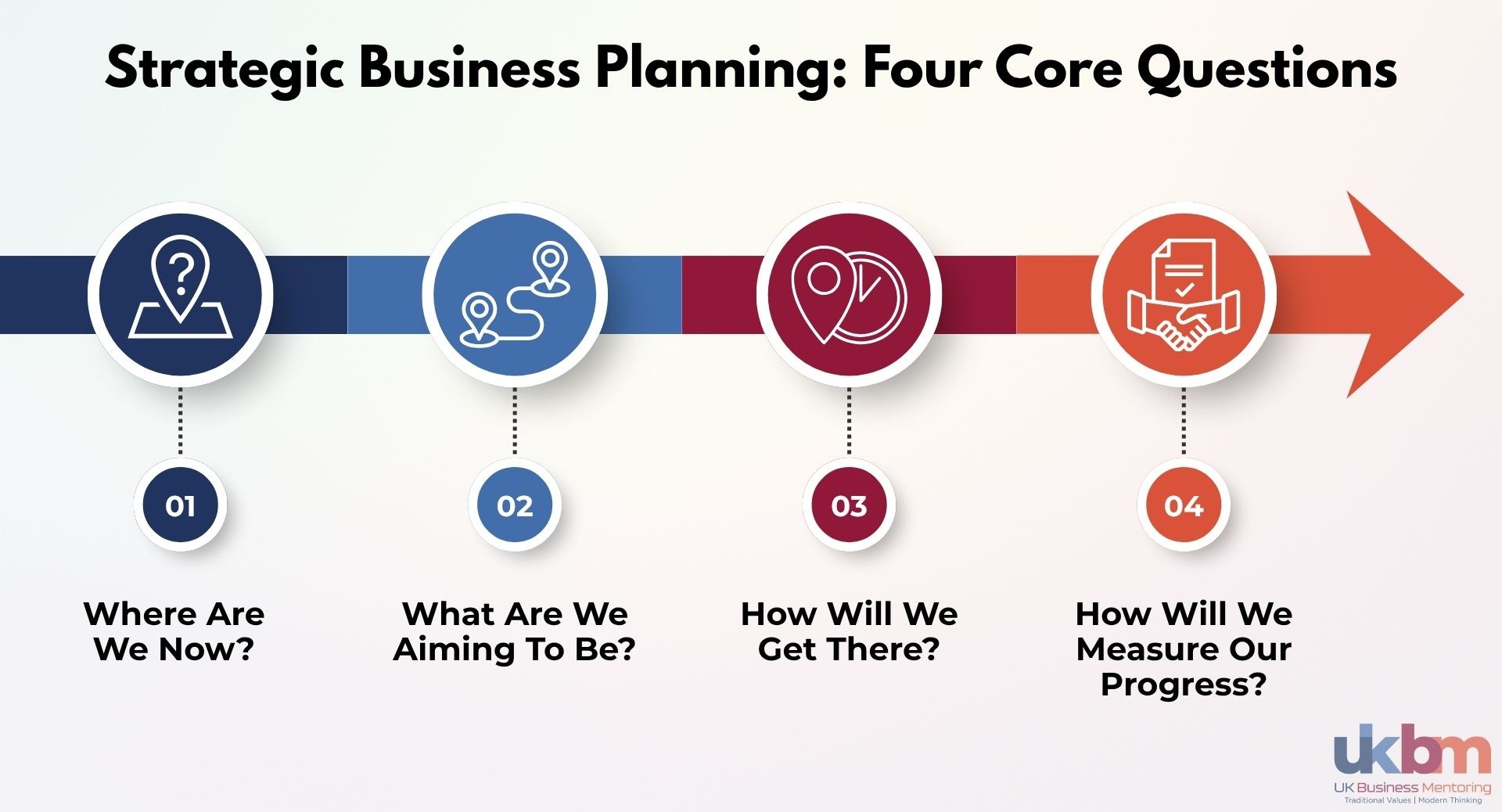
At its simplest, strategic planning is the ongoing process of defining the future direction of the business and making informed decisions about how to get there. It is not just a document; it is a disciplined way of thinking that connects ambition with action. Harvard Business School describes it as an ongoing process of using available knowledge to document a business’s intended direction.
A useful way to think about strategic business planning is through four core questions:
- Where are we now?
- What are we aiming to be?
- How will we get there?
- How will we measure our progress?
These questions matter because they force business owners to move beyond instinct and habit. They create a structure for honest review, sharper decision-making, and more focused growth.
Is a Strategic Plan the Same as a Business Plan?
Not quite. The terms are related, but they are not interchangeable.
A strategic plan sets the long-term direction. It defines the bigger picture: your priorities, competitive position, major goals, and the choices that will shape the future of the business. A business plan is usually more detailed and operational. It often explains the route map, financial assumptions, specific actions, and shorter-term steps needed to execute that direction.
In other words, your strategy tells you where you are going and why. Your business plan explains how you will organise resources and activities to move in that direction.
Why Is a Strategic Plan Crucial for Growth?
Without a strategy, many businesses stay busy but do not move forward with purpose. They react to issues as they arise, chase opportunities that may not fit, and struggle to align the wider team around the same priorities. A strategic plan reduces that drift. 95% of businesses in the UK never truly scale, and one of the key reasons for that is that they don’t have a strategy for growth.
The practical benefits of strategic planning include:
- Clearer Direction: It helps the business define what success looks like and where to focus.
- Better Alignment Across Teams: People understand the wider objectives and how their work contributes to them.
- Smarter Use of Time & Resources: Effort and investment can be directed toward the most important priorities.
- Stronger Progress Towards Goals: Success becomes easier to monitor because goals, timelines, and measures are defined in advance.
This is especially important for growing businesses, as growth exacerbates shortcomings in the business model. More people, more customers, more decisions, and more pressure can expose gaps in direction. A strong strategic planning process gives the business a framework for making decisions consistently, rather than emotionally or reactively.
It also improves engagement. When teams can see the link between their day-to-day work and larger business objectives, goals become more meaningful. People are more likely to take ownership when they understand not just what they are doing, but why it matters.
Let’s also not forget the importance of strategy for the business owners/shareholders. A business with a clear strategy is more likely to scale, more likely to make more profit, and more likely to be a saleable business. This, in turn, means a stronger asset for the shareholders and a more lucrative exit.
What Does a Strong Strategic Planning Process Involve?
A useful strategic planning framework does not need to be overcomplicated. In fact, UKBM’s own approach stresses the value of keeping strategy simple, because simple is far more likely to be used. The strength of the process comes from clarity, consistency, and honest thinking.
Step 1: Where Are We Now?
Start with reality.
This means reviewing your current position honestly: performance, profitability, capacity, market position, customer experience, sales effectiveness, leadership capability, and operational strengths or weaknesses. It also means looking outside the business at market trends, risks, competitor activity, and changing customer expectations.
This stage should surface facts, not assumptions. What is working? What is slowing growth? Which problems are symptoms, and which are root causes? The clearer this picture is, the stronger your strategy will be.
Step 2: What Are We Aiming To Be?
Once the current position is clear, the next step is to define the future state.
What kind of business are you trying to build? What do you want it to be known for? What level of scale, profitability, resilience, or owner freedom are you aiming for? Strategic development requires ambition, but it also requires specificity. Broad statements are not enough. Your future direction should translate into clear objectives, goals, solutions, and priorities.
This is where many businesses benefit from challenging conversations. The right target is not always “more.” Sometimes it is better margins, stronger systems, better leadership, a more valuable client base, or a more sustainable operating model.
Step 3: How Will We Get There?
This is where strategy becomes practical.
To move from vision to delivery, the business needs a set of coherent choices. Which markets will you prioritise? What will you stop doing? What capabilities need to improve? Which people, systems, or structures need to change? What milestones matter first?
This part of the strategic planning process should produce clear actions with named responsibilities. A strategy without ownership usually becomes a wish list. A strong plan assigns priorities to the right people, supported by timelines, resources, and accountability.
This is also where the difference between strategic and operational planning becomes important. Strategy defines the major choices and direction. Operational planning manages the day-to-day execution. One sets the course; the other keeps the engine running.
Step 4: How Will We Measure Our Progress?
A strategy is only useful if you can track whether it is working.
That means setting measures that reflect real progress, not just activity. Depending on the business, this might include profit margin, recurring revenue, client retention, conversion rates, staff performance, productivity, customer satisfaction, or progress against key initiatives.
Reviewing the plan regularly is important, as business changes, market shifts, and plans need adjusting. Strategic planning should be active and ongoing, not something written once and forgotten.
Who Needs to Be Involved in Your Strategic Planning?
Strategy should not sit only with the owner.
Depending on the size and stage of the business, useful contributors may include:
- Senior managers and department heads
- Team members close to operations or customers
- Consultants or specialist advisers
- Clients or customers
- External stakeholders such as partners, funders, or board members
Involving the right people improves buy-in and helps avoid blind spots. It also increases the chances that your strategic planning will translate into action rather than remain a leadership exercise disconnected from reality.
How Can a Business Mentor Support Your Strategic Business Plan?
One of the biggest reasons strategic plans fail is not lack of effort, but lack of perspective, challenge, and follow-through.
A business mentor brings all three. An experienced mentor helps business owners step out of the noise of daily operations, ask better questions, challenge assumptions, and turn broad ambition into specific priorities.
That outside view is valuable because owners are often too close to the business. A mentor can help identify gaps, sharpen objectives, prioritise solutions, and hold the business accountable for execution. Just as importantly, they can help simplify strategy so it becomes usable. That creates confidence, momentum, and a better chance of long-term business success.
For many owners, working with a mentor also makes the process less overwhelming. Instead of trying to build a strategy alone, they have someone to guide deeper thinking, test decisions, and keep the plan connected to measurable outcomes.
Arrange a Strategy Planning Session Today
If your business is busy but lacking clarity, now is the time to step back and build a plan that supports real growth. At UKBM, we help business owners create practical, insight-led strategies that align vision with action, involve the right people, and deliver measurable progress.
If you want a strategic plan that truly works for your business, arrange a strategy planning session today and start building a clearer path to success.
Latest Posts
- How Much Does a Business Mentor Cost?
- Seven things to consider if you ever want to sell your business
- The Franchisee Life Cycle: From Child to Adult
- The Life Cycle of a New Franchisee: From Excitement to Excellence
- Why Franchising Continues to Outperform Traditional Start-Up Businesses
- 7 Strategic Planning Mistakes That Derail Business Growth (& How to Avoid Them)
- Strategic Planning vs Business Planning: What Is the Difference?
- UKBM Welcomes Juan Pietri to the Team
- Why Strategic Planning Is Crucial for Your Business
- UKBM Named Among The Times Top 10 UK Business Support Experts
- Our MD Joe Hinton Featured in What Franchise Magazine
- UKBM are pleased to welcome Russell Fennell to the team
London & The South East
UK Business Mentoring
Hill House
67 Chequers Lane
Walton on the Hill
Surrey
KT20 7QB
Manchester & The North
UK Business Mentoring
8 Church Croft
Bury
BL9 8JD